
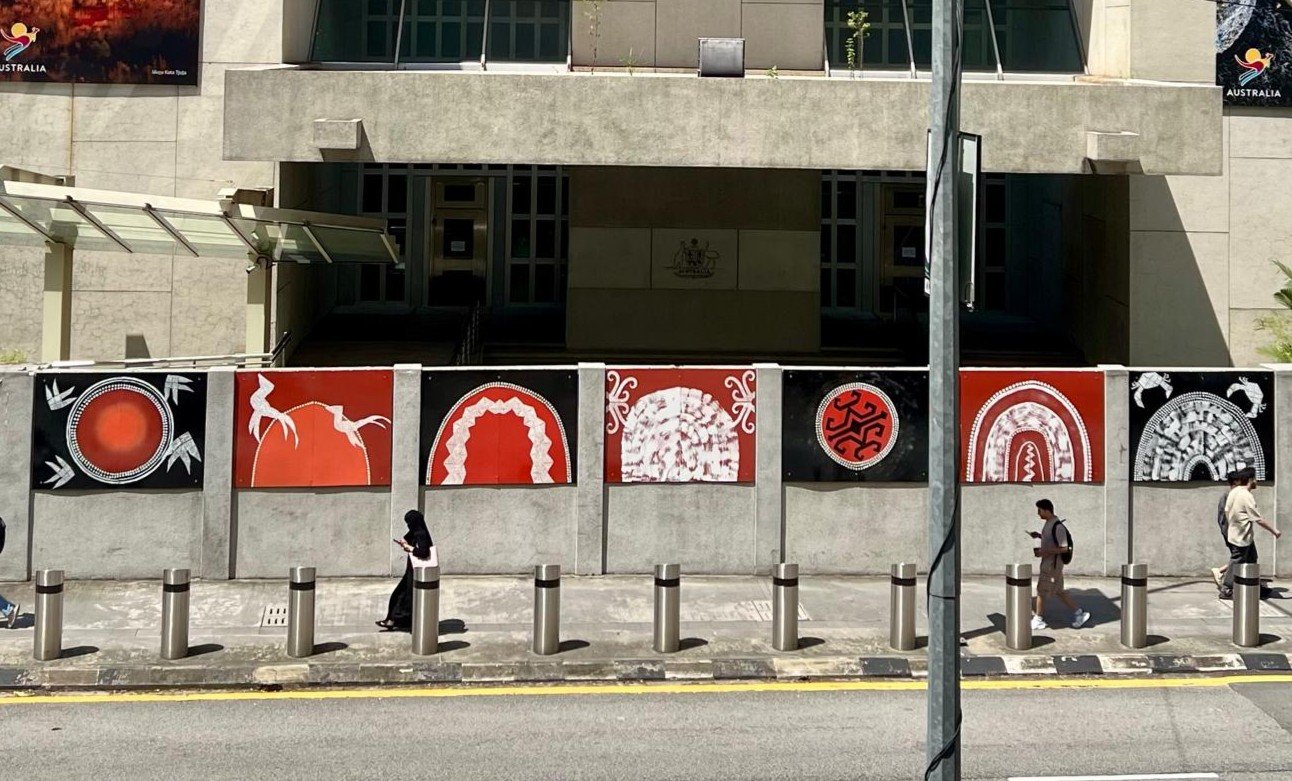
In late 2025, the Australian High Commission installed a First Nations-themed mural on the front fence of the chancery to celebrate the 70th anniversary of Australia’s diplomatic presence in Malaysia.
The mural was developed by Australian Aboriginal artist Professor Wayne Quilliam and Malaysian Orang Asli artist Mr Shaq Koyok. The paint used for the mural incorporated Australian ochre, a natural clay earth pigment that has been traditionally used by First Nations peoples in Australia for ceremony and art for thousands of years. In line with the design’s focus on the environment and nature, the mural was painted on innovative Malaysian-made ECOPEAL panels – made entirely from recycled drink containers.
The artwork draws on Prof. Quilliam’s Palawa heritage, taking inspiration from the story of Bunjil, the great wedge-tailed eagle that created the earth and the sky. The panels also include elements inspired by traditional Temuan weaving from Mr Koyok’s community.
Together, the mural symbolises the deep connections between Australia and Malaysia and our First Nations communities.
Artist Biographies
Shaq Koyok is an award-winning Malaysian contemporary artist and activist of the Temuan Orang Asli (indigenous) community, known for combining powerful visual art with advocacy for indigenous rights and the environment. Shaq holds an honours degree in Fine Arts from Universiti Teknologi MARA and works across a range of mediums including painting, installation, and mixed media. His works have been exhibited widely in Malaysia and internationally, and he has spoken at global arts and environmental forums. Through his art, he promotes pride and visibility for indigenous cultures within Malaysia and beyond.
Aboriginal Artist Professor Wayne Quilliam is one of Australia’s pre-eminent artists, curators and cultural advisers working on the International scene. His award-winning career includes the coveted NAIDOC Aboriginal Artist of the Year, Human Rights and Walkley Awards and numerous Art honours. He has created and curated over 300 exhibitions throughout the world and continues to explore new artistic practices to share Indigenous culture.
“My work in its purest essence is the evolution of spiritual connection in a contemporary world. Mother Earth is a living, breathing entity that inhales and exhales with us, she has a heart and spirit that sings songs for those who know how to listen”.
“Inspiration for these artworks come from the Traditional people of the land, their stories and experiences, their laughter and tears form the completed art”.
Mural Panels
|
|
|
.jpeg)
.jpeg)
Bunjil Lifts the Sky
In the beginning, the land was flat and the sky lay heavy upon the people. They could not stand tall or see far. Bunjil spread his great wings and lifted the sky upward, creating space for trees to grow and rivers to flow. From above, he called to the people, reminding them that with freedom comes responsibility—to care for the land that now had room to breathe.
|
|
|
.jpeg)
The Law in the Feathers
Bunjil flew across the country, dropping feathers where people gathered. Each feather carried a law: share food, respect elders, protect water, and care for Country. When disputes arose, the people looked to the feathers and remembered Bunjil’s guidance. His spirit lived not in anger, but in balance.
|
|
|
.jpeg)
Baiyami
Before the world had shape, there was only a soft darkness that breathed like a sleeping animal. Into this quiet came Baiyami, the Sky Father, stepping down to the earth his footprints became the first hills.
Baiyami looked upon the dark land and felt its loneliness. He reached into his chest and pulled out a spark — a piece of his own spirit — and threw it across the sky. It burst into the First Light, scattering into the sun, the stars, and the shimmer that dances on water at dawn.
With light came movement. Rivers woke and began to carve their paths. Trees stretched upward, remembering the warmth of Baiyami’s hands. Animals emerged from the cracks in the earth, blinking at the new world.
Baiyami taught the first people how to live with the land, not above it. When his work was done, he stepped back into the sky, where he still watches, his spirit glowing in every sunrise.
.jpeg) |
|
Waru
In the red heart of the continent, the nights were once so cold that even the stars shivered. The people huddled together, unable to hunt or travel far. Seeing their struggle, Waru, the Fire Brother, emerged from a glowing ember hidden deep inside a desert stone.
Waru danced across the land, leaving trails of flame that didn’t destroy but renewed. Spinifex seeds burst open in his footsteps. Kangaroo grass grew tall and sweet. Animals returned to places long barren.
He approached the people and placed a burning coal in their hands.
“This is not mine,” he said. “It belongs to the land. Use it with care, and it will feed you, warm you, and guide you.”
The people learned to burn Country properly — small, cool fires that healed the earth. Waru still travels with them in ceremony, in cooking, in the glow of campfire stories. When sparks rise into the night, they say Waru is laughing.
.jpeg) |
|
Yirral
In the time before plants, the world was bare and hungry. The soil waited, silent and expectant. Into this emptiness came Yirral, the Seed Mother, carrying a coolamon filled with tiny sparks of life.
She walked across the plains, scattering seeds with each step. Where they landed, grasses unfurled like green waves. Flowers burst open in colours the world had never seen. Trees rose slowly, stretching their arms toward the sky.
Yirral taught the people how to care for the plants — when to harvest, when to burn, when to let the land rest. She showed them that every seed holds a story, and every plant remembers the hands that tend it.
When the wind ripples through tall grass, people say Yirral is passing through, checking that her children still grow strong.
|
|
|
.jpeg)
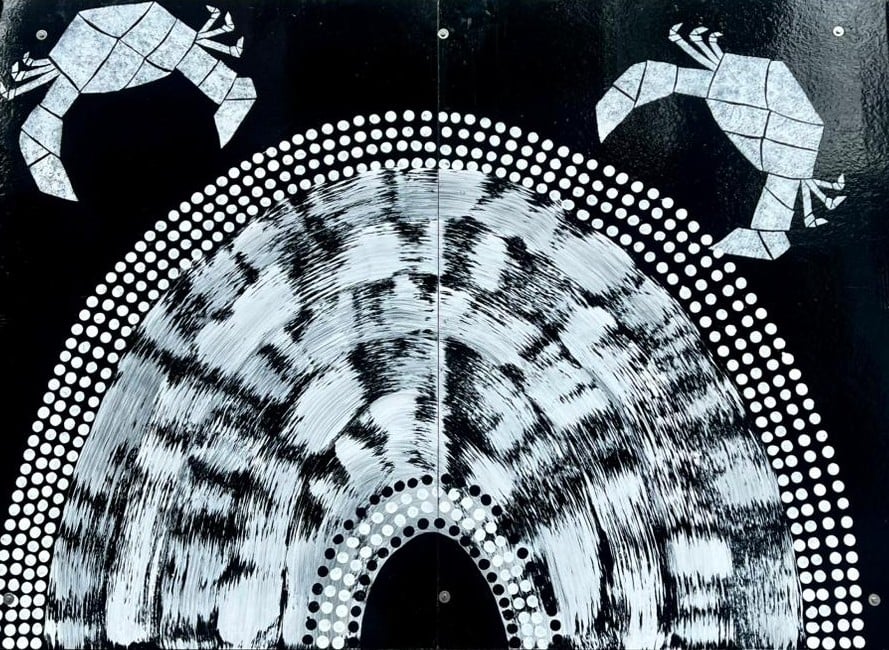
6 Seasons
We listen to the winds, waiting for the spirits to
tell us —
when to burn gently,
when to hunt,
when to let the land rest.When people forgot, the rains came too strong.
Fires burned too hot.
Through stories and ceremony, they remembered the ancient ways.
They learned again to work with the land, not against it.
 |
|
Mina
Before the trees had leaves and before birds learned to fly, the world was still and heavy. Into this stillness came Mina, the Wind Weaver, a spirit with hair made of clouds and footsteps as soft as mist.
Mina moved through the world, weaving invisible pathways. Her breath shaped the curves of sand dunes. Her fingers carved valleys between mountains. She whispered to the trees, teaching them how to sway. She lifted the wings of the first birds, showing them how to ride her currents.
But Mina also carried messages. She brought warnings of storms, signs of change, and the voices of ancestors travelling across Country.
When people feel a sudden breeze on a quiet day, they say Mina is passing through, checking that everything — and everyone — is in balance.